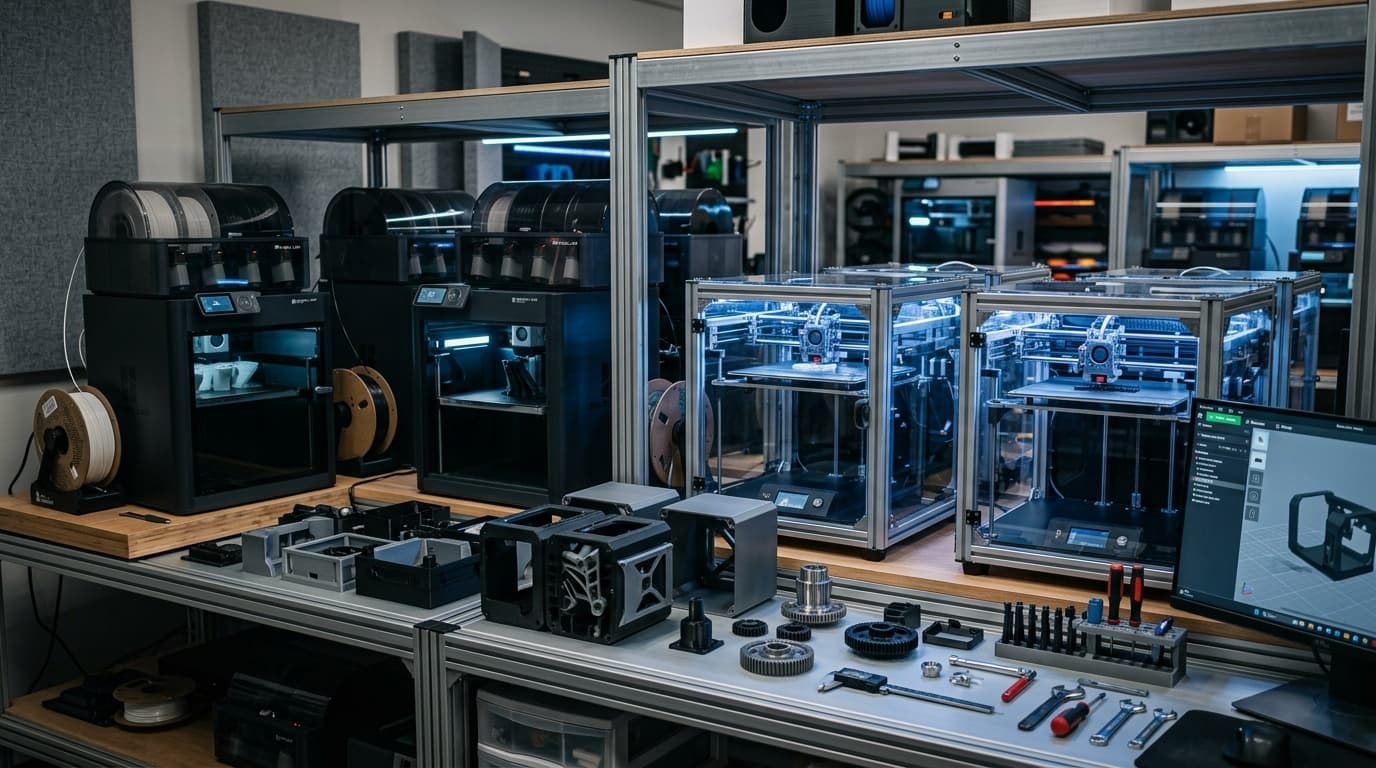
Quick answer: what an industrial 3D printing service includes
A complete industrial 3D printing service covers five stages. The printing itself is only one of them.
| Stage | What a good provider does | Red flag |
|---|---|---|
| Requirement review | Asks about loads, temperature, chemicals, mating parts and quantity | Only asks for an STL and a colour |
| Design for additive (DfAM) | Suggests wall thickness, orientation, inserts and support changes | Prints the file exactly as sent, whatever the geometry |
| Process and material choice | Recommends FDM, SLA, SLS or another process for the part's job | Offers one process for everything |
| Production | Fixed settings, recorded orientation, consistent material | Settings change from batch to batch |
| Post-processing and checks | Support removal, inserts, finishing, fit or dimension checks | Ships parts straight off the build plate |
If a provider covers all five, you are buying engineered parts. If it covers only production, you are buying print time and taking on the engineering risk yourself.
Industrial vs consumer print services
Consumer print services are built for one-off models, cosplay and hobby parts: upload a file, pick a colour, get a print. Industrial services are built for parts that go into equipment, so the questions change. Will the bracket creep under a constant load? Will the housing warp next to a motor? Will the jig still locate the part after a thousand cycles? Does batch two match batch one?
The difference shows up in the conversation before the quote. An industrial provider will ask about the application, may suggest a different material or orientation, and will flag geometry that will print badly. That conversation is the service.
Which process for which part: FDM, SLA, SLS and beyond
Each process has a clear sweet spot. The tolerances below are typical ranges; real accuracy depends on the machine, part size, geometry and material, so confirm critical dimensions with the provider.
| Process | Best for | Typical materials | Typical accuracy | Watch out for |
|---|---|---|---|---|
| FDM | Tough functional parts, jigs, fixtures, brackets, housings | PLA, PETG, PETG-CF, ABS, ASA, TPU, nylon | about ±0.2-0.5 mm | Weaker between layers; orientation matters |
| SLA (resin) | Fine detail, small parts, smooth surfaces, fit models | Standard, tough and clear resins | about ±0.1-0.2 mm | Resins can be brittle and age in UV |
| SLS / MJF | Complex nylon parts, snap fits, batches of small parts | PA12, PA11, glass-filled nylon | about ±0.3 mm | Grainy surface; usually outsourced |
| Metal (DMLS / SLM) | Complex metal parts, heat exchangers, lightweight brackets | Aluminium, stainless steel, titanium | Machined faces for fits | High cost; needs machining after printing |
For most industrial work, such as fixtures, robot parts, enclosures and ducts, FDM in an engineering material is the most cost-effective choice. SLA earns its place when detail or a smooth surface matters. SLS makes sense for complex nylon parts in batches. For a deeper comparison of the two most common processes, see FDM vs SLA: which to choose.
Materials for industrial parts
The material should be chosen from the part's job, not from what's loaded in the printer. A quick guide:
| Requirement | Good starting material |
|---|---|
| General functional part, indoor | PETG |
| Stiff structural bracket or robot part | PETG-CF (carbon-fibre filled) |
| Heat near motors or outdoors in sunlight | ABS or ASA |
| Flexible seal, bumper or grip | TPU 95A |
| Fine detail or smooth cosmetic surface | SLA resin |
| Wear, snap fits or complex batch parts | Nylon (PA12) |
PLA is excellent for concept models and fit checks but softens at fairly low temperatures, so it is rarely the right choice for a part that sits in a machine. For a detailed comparison of the common filaments, read PLA vs ABS vs PETG and the best filaments for functional parts.
8 questions to ask an industrial 3D printing provider
1. Will an engineer review my part before printing, and will you suggest changes if something won't work? 2. Which processes do you run in-house, and which do you outsource? 3. How do you choose the material, and can you explain why for my part? 4. How do you decide print orientation, and do you record it for repeat orders? 5. Can you install heat-set inserts, add threads or do basic assembly? 6. How do you keep repeat batches consistent with the first one? 7. What checks do you do before shipping: visual, fit, or measured dimensions? 8. Will you sign an NDA before I share CAD files?
Clear, specific answers to these matter more than the size of the machine list.
What to send for an accurate quote
You will get a faster, more accurate quote if you send:
- CAD in STEP format (STL works for printing but loses the exact geometry an engineer needs to review or modify the part) - Quantity, and whether you expect repeat orders - Operating conditions: load, temperature, outdoor use, chemicals, vibration - Critical dimensions and mating parts: which holes, faces or fits must be exact - Finish and colour requirements - Deadline
If you don't have CAD yet, a sketch with dimensions and a description of what the part does is enough to start. For more on how the overall process works, see 3D printing for product development.
What drives the cost
Industrial print pricing comes down to a few factors: material volume, machine time (largely set by part height and layer height), supports and post-processing, the engineering review, and quantity. Tall parts, heavy infill, lots of supports and tight finishing requirements all push the price up. Batches bring the cost per part down because setup and review are shared. For typical price ranges and worked examples, read the cost of 3D printing in India.
When 3D printing stops making sense
3D printing wins when quantities are low, designs are still changing, or the geometry is too complex to mould or machine economically. As quantities grow and the design freezes, injection moulding or CNC machining usually becomes cheaper per part, even after paying for tooling. A good provider will tell you when you are approaching that point instead of continuing to print. If you are in that range, see our low-volume production service.
How we handle industrial printing at YantriX
We run FDM and SLA printing in-house at our studio in Surat, Gujarat, along with heat-set insert installation and basic assembly. SLS nylon and CNC machining are coordinated through manufacturing partners when a part needs them. Every job starts with an engineering review of the part's function, and our mechanical team can modify the CAD for printing or design the part from scratch. We work with OEMs, robotics companies and manufacturers in India and abroad; files and design questions are handled digitally, and an NDA can be signed before you share files. See our industrial 3D printing services, our jigs and fixtures service, or request a production quote.