Quick answer: when FDM is the right process
FDM is the best choice for most functional polymer parts at low to medium quantities: brackets, mounts, housings, enclosures, cable guides, ducts, jigs, fixtures and robot parts. It is the most cost-effective process for these parts, offers the widest choice of engineering materials, and produces tough parts quickly.
| Choose FDM when | Consider another process when |
|---|---|
| The part carries load, heat or impact | You need very fine detail or a smooth cosmetic surface (SLA) |
| You need engineering materials (PETG-CF, ABS, ASA, TPU) | You need complex nylon parts in larger batches (SLS) |
| Quantities are one to a few hundred | Quantities are in the thousands (injection moulding) |
| Parts may change between batches | You need metal (CNC machining or metal printing) |
| Cost and speed matter more than surface finish | Tolerances tighter than about ±0.1 mm are needed (machining) |
For a direct comparison with resin printing, see FDM vs SLA: which to choose.
Materials for functional FDM parts
Choose by what the part has to survive. Temperatures below are approximate softening points; real limits depend on the brand, the load on the part and how long it is exposed.
| Material | Best for | Softens around | Notes |
|---|---|---|---|
| PLA / PLA+ | Concept models, fit checks, light-duty fixtures | 55-60 °C | Stiff and accurate, but creeps under load and softens in a hot car or near motors |
| PETG | General functional parts, housings, brackets, fixtures | 75-80 °C | Tough, good chemical resistance, the default choice for most parts |
| PETG-CF | Stiff structural brackets, robot parts | 75-80 °C | Carbon-fibre filled: stiffer and more dimensionally stable than PETG |
| ABS | Enclosures and parts near heat | about 100 °C | Good heat resistance; needs controlled printing to avoid warping |
| ASA | Outdoor parts, enclosures in sunlight | about 100 °C | Like ABS with UV resistance |
| TPU 95A | Seals, bumpers, grips, cable strain relief | Flexible | Rubber-like and impact-absorbing |
Nylon and carbon-fibre nylon suit wear parts and higher loads; ask for availability when you request a quote. For a deeper comparison, read PLA vs ABS vs PETG and the best filaments for functional parts.
Tolerances and fits
Typical FDM accuracy is about ±0.2-0.5 mm, depending on part size, geometry, material and orientation. Small features and dimensions in the plane of the layers are usually more accurate than heights and large parts. Design for that instead of fighting it:
| Feature | Starting point |
|---|---|
| Sliding or easy fit between printed parts | 0.3-0.5 mm total clearance |
| Snug fit | 0.15-0.25 mm clearance, test with a sample first |
| Holes | Print slightly undersize and drill or ream to final size if accuracy matters |
| Heat-set inserts | Use the hole size the insert manufacturer specifies for plastics |
| Critical faces or bores | Machine after printing, or mark them for checking |
These are starting points; the right clearance depends on the material and printer, so test fits on a sample before a batch. Mark the critical dimensions on your drawing or in your enquiry, so the provider knows which ones to orient for and check.
Design rules for strong FDM parts
A few rules make the biggest difference to strength:
1. Orientation: layers bond less strongly than the material within a layer. Orient the part so the main load runs along the layers, not across them. A hook or bracket should usually be printed lying down, not standing up. 2. Walls before infill: strength comes mostly from the outer walls. Several perimeters (for example 3-5 with a 0.4 mm nozzle) usually add more strength than raising infill. 3. Fillets: round internal corners to spread stress, especially where a bracket arm meets its base. 4. Overhangs: keep unsupported overhangs under about 45° from vertical, or plan for supports and their marks. 5. Threads: use heat-set brass inserts for anything assembled more than a few times. Threads cut directly into plastic wear out quickly. 6. Minimum features: keep walls at least about 1.2 mm thick and pins and bosses thick enough to survive assembly.
For the full checklist, see our design for 3D printing (DfAM) checklist.
Lead times
Lead time depends on part size, quantity, material and finishing, so a good provider confirms it at quotation rather than promising a fixed number. As a guide, small parts in standard materials are typically ready in days, and small batches of tens of parts within one to two weeks, with extra time for inserts, assembly or finishing. In one project described in our cost guide, 80 PETG-CF gripper fingers with two heat-set inserts each were delivered in 7 working days.
You can shorten lead time by sending complete information up front: CAD in STEP format, quantity, material or operating conditions, and the critical dimensions.
What FDM parts cost
FDM is the lowest-cost process for functional parts. Typical Indian prices for a small part around 50 mm are about ₹150-₹500 in PLA or PETG and ₹250-₹700 in ABS or ASA, with carbon-fibre filled materials costing more. Batches bring the price per part down: 25 units often get 10-15% off the single-part price, and 100 units 20-30% off. Heat-set inserts, finishing and assembly are extra and should appear as separate lines in the quote. For full price ranges and a worked example, read the cost of 3D printing in India.
What to send for an FDM quote
Send these with your enquiry for an accurate quote:
- CAD in STEP format (STL is fine for printing, but STEP lets an engineer review and modify the part) - Quantity, and whether orders will repeat - What the part does: loads, temperature, outdoor use, chemicals - Critical dimensions and mating parts - Inserts, finishing or colour requirements - When you need the parts
No CAD yet? A dimensioned sketch or a sample part is enough to start.
FDM printing at YantriX
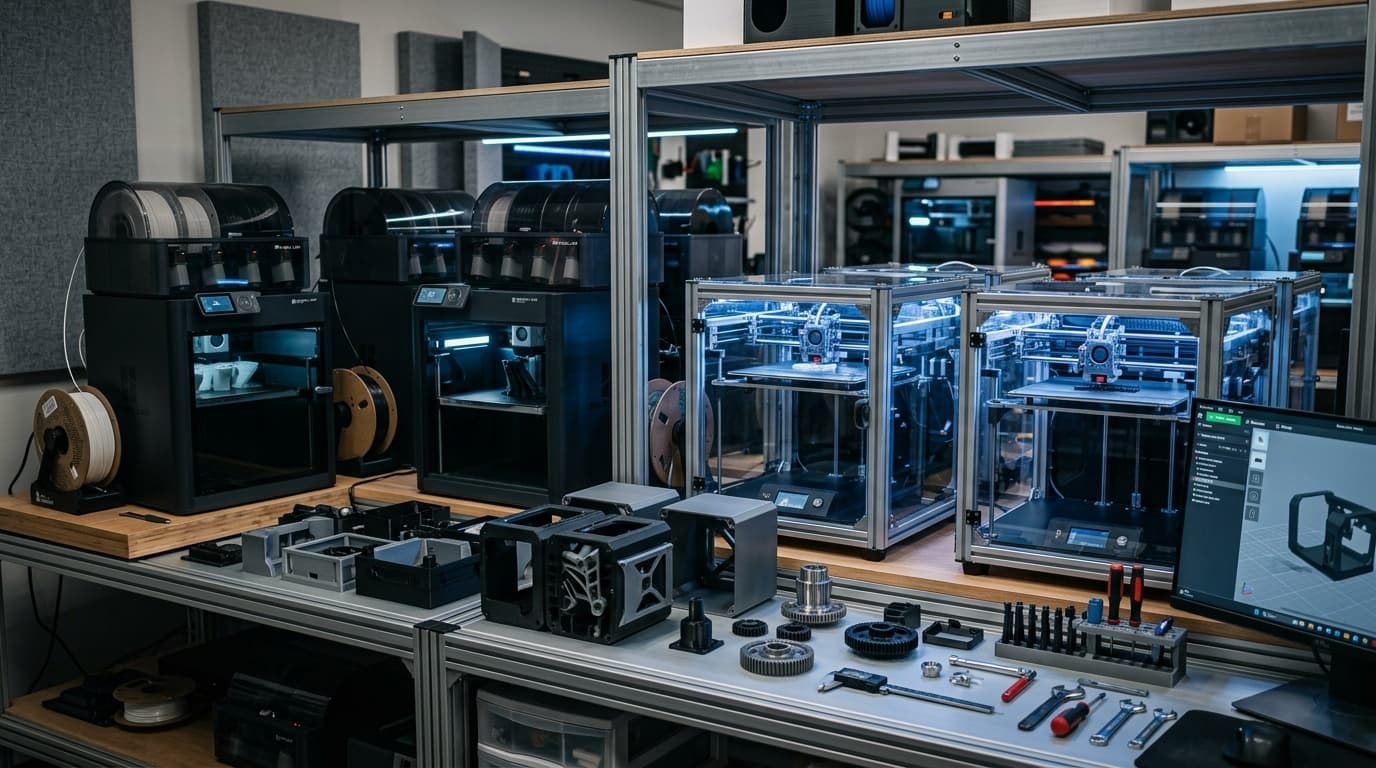
We run FDM in-house at our studio in Surat, Gujarat, in PLA, PETG, PETG-CF, ABS, ASA and TPU, alongside SLA for fine-detail parts. Every job starts with an engineering review of what the part has to do, and our mechanical team adjusts the design for printing where it helps. Heat-set inserts and basic assembly can be included, and repeat batches are built from the approved design, material and orientation. We work with teams across India and abroad. See our 3D printing services, industrial 3D printing for production parts, or request a quote.