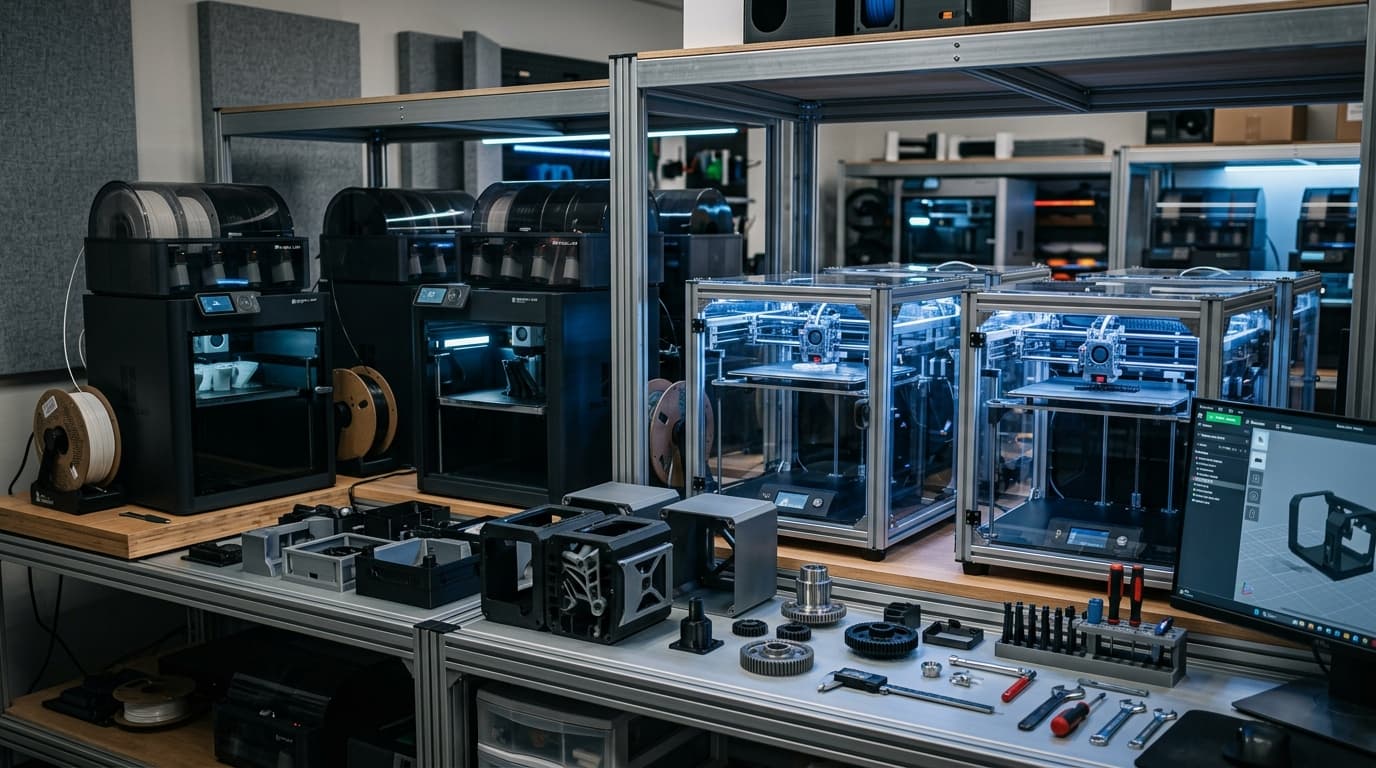
PETG-CF — carbon-filled PETG, the upgraded default
PETG with chopped carbon fibre — about 2x stiffer than plain PETG, holds shape under load far better, and prints almost as easily on the same machines. The carbon fibre wears nozzles fast (use a hardened steel nozzle). We use PETG-CF for drone arms, robotic linkages, motor mounts, and any load-bearing bracket where plain PETG flexes too much.
Nylon — PA6, PA12, and PA-CF
Nylon is the toughest commonly-printed thermoplastic. PA6 and PA12 are flexible-tough — they bend rather than crack, survive repeated snap-fit cycles, and have low friction (good for gears, bushings, sliders). Nylon is hygroscopic, so spools need dry storage. Carbon-filled Nylon (PA-CF) is stiffer at a small ductility cost.
ASA — outdoor ABS without the yellowing
ASA prints almost identically to ABS — needs an enclosed printer, ~250°C nozzle, heated bed, vapor-smoothable in acetone — but is UV-stable. Plain ABS yellows and cracks within months of outdoor exposure; ASA holds its color and properties for years. Use ASA for outdoor enclosures, automotive aftermarket parts, drone housings.
Polycarbonate — the strongest 3D printing thermoplastic
Polycarbonate (PC) prints around 270-300°C with a heated bed at 110°C+ inside a fully enclosed printer — most hobby printers can't run it, but production-grade machines (Bambu X1C, Raise3D, QIDI) can. The reward is the strongest commonly-printed thermoplastic, with high heat tolerance and impact strength.
TPU and flexible filaments
TPU 95A (medium-soft) is the standard flexible filament — prints reliably on direct-drive printers, makes good gaskets, vibration mounts, soft grips, and protective bumpers. For a stretchy, tough functional part, TPU 95A is the right answer 90% of the time.
What we stock at YantriX
Our Surat studio keeps PLA, PLA+, PETG, PETG-CF, ABS, ASA, TPU 95A, and Nylon (PA12 + PA-CF) in regular stock across the common colors. Polycarbonate and specialty grades (high-temp, ESD-safe, food-safe) are bookable on 2-3 days notice. Every spool we run is from a major brand and goes through QC before it goes on a production printer.