01
Structural
- Static structural analysis
- Stress and deformation
- Load-path evaluation
- Stiffness assessment
- Geometry and thickness iteration
Validate strength, stiffness, vibration behaviour and structural risk before committing to fabrication or tooling. YantriX combines finite element analysis with mechanical CAD redesign and physical product development.
Engineering simulation for real hardware
CAD → FEA → Engineering decision → CAD redesign → Prototype / iteration
Simulation results are interpreted against the defined assumptions and used to guide practical mechanical design changes.
Structural studies are scoped around the component, load case, and engineering decision required.
01
02
03
04
These engineering studies use the project assumptions and simulation results recorded for each case. Numerical values below are identified as simulation results or inputs.
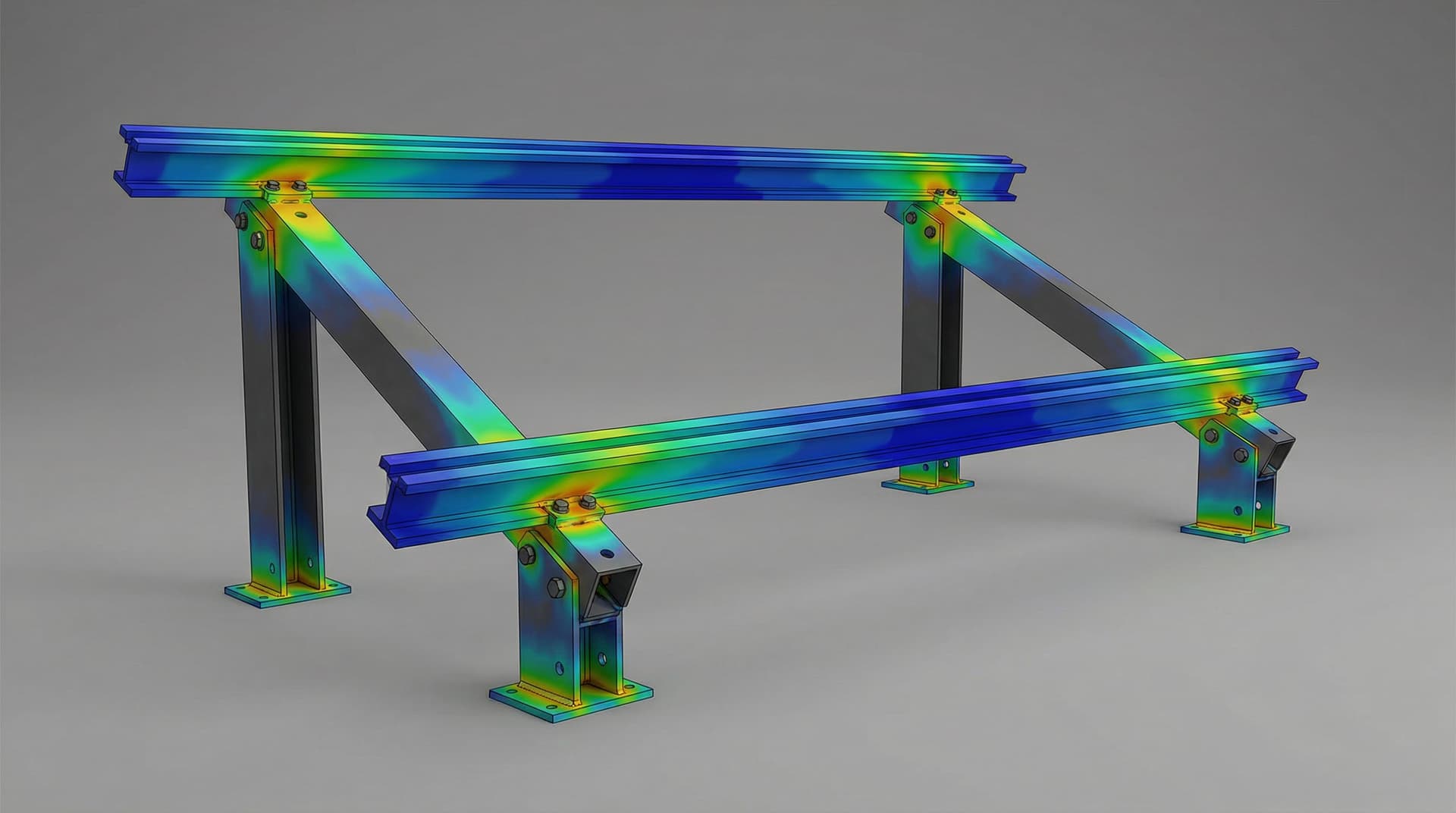
ENGINEERING STUDY · Simulation · Structural FEA & Optimization
Structural engineering study evaluating stress concentrations, deflection, and material optimization on heavy-duty industrial mounting brackets using finite element analysis.

ENGINEERING STUDY · Simulation · Topology Optimization & FEA
Airframe engineering study using topology optimization and modal FEA to compare structural mass and predicted vibration behaviour across a CAD design iteration.
A colourful stress plot is not engineering validation. Useful FEA depends on realistic loads, material assumptions, boundary conditions, mesh quality, convergence, and interpretation.
Define the stress, deformation, stiffness, frequency, safety margin, or design comparison to evaluate.
Simplify non-structural detail while retaining features that carry load or define interfaces.
Set material properties for the component and its intended manufacturing process.
Represent supports, forces, interfaces, and operating loads from the available requirements.
Refine holes, fillets, interfaces, load paths, and regions with steep stress gradients.
Compare important quantities across mesh refinement where required by the study.
Use reaction-force checks, hand calculations, or engineering sanity checks where appropriate.
Translate findings into CAD changes and rerun the analysis when included in scope.
Compare predictions with prototype or measured results when project scope includes testing.
Early-stage CAD is acceptable when study assumptions can be defined clearly. NDA coordination is available before confidential data exchange.
Deliverables, mesh detail, and CAD revisions are agreed for each project scope.
Brackets, frames, machine structures, mounting systems, and load-bearing assemblies.
Arm links, actuator mounts, robot chassis, and vibration-sensitive structures.
Airframe stiffness, modal behaviour, and structural weight studies.
Housings, supports, structural components, and mechanical assemblies.
A few practical details about starting a simulation engagement.
A 3D CAD model, material, expected loads, support or mounting conditions, operating environment, design limits, and the question you need answered are useful starting points. Early CAD is acceptable when assumptions can be defined clearly.
Yes. An early-stage model can support an initial study when we can agree on the assumptions, load cases, and performance target. Simulation predictions should be interpreted within those defined conditions.
Share your CAD, operating assumptions, and the engineering decision you need to make. We’ll review the scope and discuss an appropriate next step.