01
Thermal management
- Electronics and enclosure cooling
- Hotspot identification
- Heat-sink and fin studies
- Natural convection
- Forced-air cooling where supported
Understand airflow, heat transfer, pressure behaviour and cooling performance before hardware is built. YantriX combines CFD with CAD redesign to convert simulation results into practical product improvements.
Engineering simulation for real hardware
CAD → CFD → Engineering decision → CAD redesign → Prototype / iteration
Simulation results are interpreted against the defined assumptions and used to guide practical mechanical design changes.
Thermal and flow studies are scoped around the product geometry, operating conditions, and performance question.
01
02
03
04
These engineering studies use the project assumptions and simulation results recorded for each case. Numerical values below are identified as simulation results or inputs.
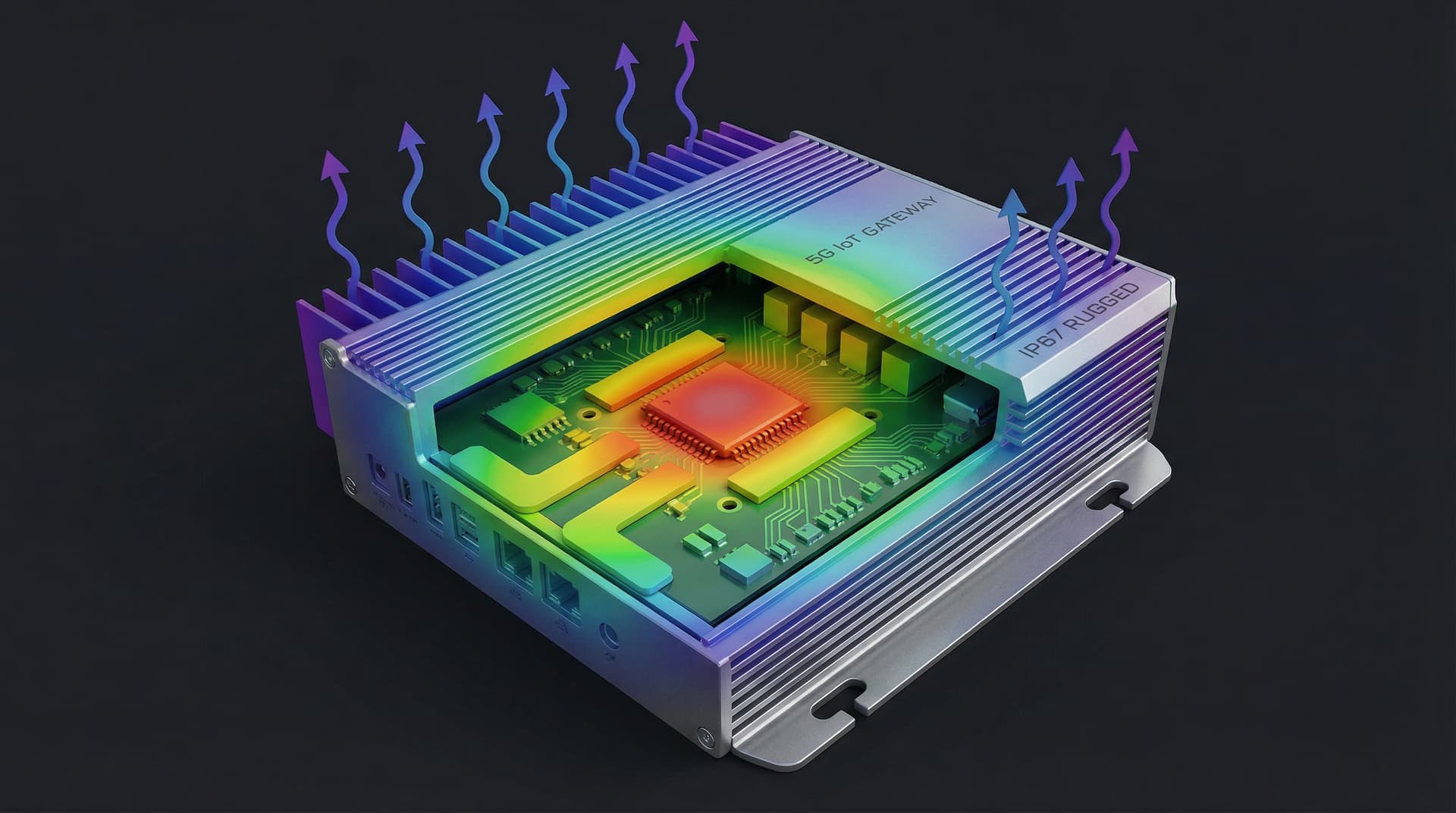
ENGINEERING STUDY · Simulation · CFD Thermal & Heat Dissipation
CFD simulation study analyzing conjugate heat transfer (CHT), hotspot dissipation, and external heat sink fin geometry for a sealed electronics enclosure operating in 45°C ambient air.
Useful CFD depends on the product geometry, operating assumptions, appropriate physical models, mesh quality, convergence, and engineering interpretation.
Define whether the study needs to predict temperature, airflow, pressure, flow distribution, or cooling performance.
Prepare the product CAD and extract the relevant fluid region.
Set solid and fluid properties for the defined operating conditions.
Define inlet and outlet conditions, pressure, heat loads, ambient temperature, and component heat generation.
Select heat-transfer, convection, and turbulence models that fit the engineering question.
Refine areas with strong velocity or temperature gradients, narrow flow paths, and thermal interfaces.
Review numerical convergence and physical balances, such as mass and thermal-energy balance, where appropriate.
Turn temperature, pressure, and velocity fields into design decisions.
Revise fins, vents, ducts, channels, component locations, or enclosure geometry and rerun where required.
Compare predictions with prototype measurements when project scope includes testing.
When early-stage information is incomplete, we can help define reasonable study assumptions. NDA coordination is available before confidential data exchange.
Deliverables, mesh detail, and CAD revisions are agreed for each project scope.
Enclosure cooling, thermal hotspots, and heat-transfer paths.
Internal airflow, pressure loss, and thermal management.
Ventilation, cooling architecture, and packaging changes.
Electronics enclosure cooling, motor-driver thermal management, and internal airflow.
A few practical details about starting a simulation engagement.
No. We also handle focused cooling and enclosure airflow studies when the goal is to answer a specific engineering question quickly.
CFD can help compare design directions before prototype testing. Predictions depend on the geometry, material properties, boundary conditions, and physics assumptions defined for the study.
Share your CAD, operating assumptions, and the engineering decision you need to make. We’ll review the scope and discuss an appropriate next step.