Thermal analysis for a sealed IP66 electronics enclosure, case study.
A sealed electronics enclosure needed reliable thermal protection under continuous operation. We ran conjugate heat-transfer CFD to find the hotspot, redesigned wall geometry and internal layout, and verified the fix before any prototype hardware existed.

Overview
Why this study matters
How CFD-based conjugate heat transfer caught a 14 °C hotspot in a sealed IP66 enclosure before prototype — saved an estimated 2 mold revisions and 7 weeks of rework.
Client: An Indian IoT product company shipping outdoor 5G gateways
Project Type: Thermal Analysis (CFD with conjugate heat transfer)
Industry: IoT / industrial electronics
Service Used: CFD Analysis + Enclosure Design
Results in numbers
What the engagement actually shipped.
- 14 °C
- Hotspot reduction
- 72 °C
- Final SoC junction temp at 45 °C ambient
- IP66
- Rating preserved
- ~7 weeks
- Avoided rework on prototype
Objectives
What the project needed to achieve
- Predict steady-state junction temperature of the hottest IC under 45 °C ambient and full load
- Identify hotspot regions inside the sealed enclosure before prototype
- Recommend wall-thickness, fin, and component-placement changes that lower hotspots without breaking IP66
- Document a thermal margin the client can defend to their compliance team
Challenge
Engineering constraint
The client needed confidence that a sealed IP66 enclosure could protect sensitive electronics in continuous outdoor operation without creating thermal hotspots. Traditional rules-of-thumb suggested vent slots, but the IP rating made venting non-negotiable — the only paths for heat were conduction through the housing and natural convection inside the sealed volume.
Approach
How Yantrix approached the work
- 01Built a CFD model of the enclosure with conjugate heat transfer — solid conduction through housing walls coupled with natural convection inside the sealed air volume.
- 02Loaded the model with realistic component power maps from the client’s electrical team and a 45 °C outdoor-rooftop ambient boundary.
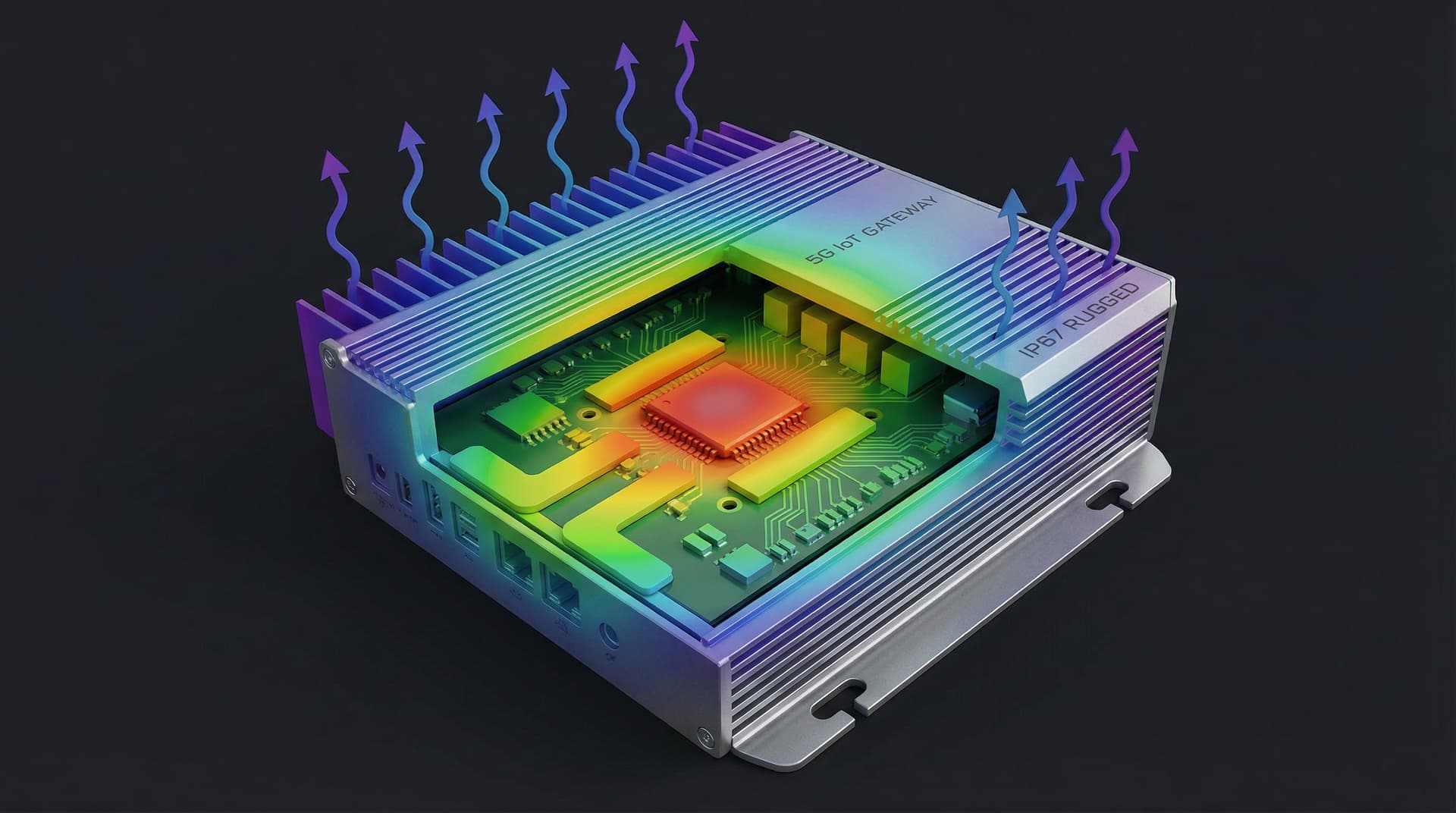
- 03Identified a 14 °C hotspot above the SoC caused by a stagnant convection cell in the upper-right corner of the enclosure.
- 04Iterated component layout (rotated the SoC PCB by 90°), introduced internal aluminium fins thermally bonded to the housing, and re-ran the CFD to verify the fix.
Outcomes
What improved by the end
- Hotspot reduced from 86 °C to 72 °C junction temperature — 14 °C margin recovered
- Component-placement change identified before PCB tooling commitment
- IP66 rating preserved — no venting required
- Thermal margin documented for the compliance file
Deliverables
What the client receives
- CFD model and conjugate-heat-transfer report with annotated screenshots
- Hotspot location map and root-cause analysis
- Updated enclosure CAD with internal fin geometry and component layout
- Thermal margin documentation for the compliance package
- Prototype validation plan with thermocouple placement guidance
Tools used
Stack and tooling
- ANSYS Fluent (CFD with conjugate heat transfer)
- ANSYS Icepak for electronics-specific airflow
- SolidWorks for parametric CAD
- MATLAB for power-map data prep
Impact
Business-level effect
- Caught a hotspot that would have surfaced only after 4–6 weeks of field testing
- Avoided an estimated two injection-mold revisions
- Gave the compliance team a defensible thermal-margin story
Conclusion
Thermal de-risking inside the CAD stage is one of the highest-leverage applied-CFD plays in product engineering — cheap to run, expensive to skip.
Next step
Building a sealed enclosure where venting isn’t an option? Send us the CAD and your component power map — we’ll model the thermal envelope before you commit to tooling.
Tagged
- Thermal Analysis
- CFD
- Conjugate Heat Transfer
- IP66
- Enclosure Design
Visual results
Key views and intermediate artefacts


After redesign — fins bonded to housing
Frequently asked questions
Answers from the engagement itself.
When should I run thermal CFD on a sealed enclosure?
Before component layout is locked in CAD. CFD with conjugate heat transfer takes a few days to set up and run; catching a hotspot there is two orders of magnitude cheaper than catching it on the first physical prototype.
Do I really need CFD if my enclosure is sealed?
Yes — especially if sealed. Sealed enclosures rely on conduction through walls and natural convection inside the cavity, both of which are hard to estimate by hand. Hand calculations work for single components in free air; sealed multi-source layouts almost always need CFD.
Related case studies
Adjacent proof you can read next.

GenAI · Retrieval-Augmented Generation
Production RAG over 40,000 engineering documents
How a hybrid-search RAG system over 40k engineering PDFs and CAD drawings cut average engineer-question turnaround from 35 minutes to 22 seconds, with grounded citations on every answer.

MLOps · Edge AI Fleet
MLOps platform for a 600-device edge AI fleet
End-to-end MLOps platform managing 600 Jetson inspection cameras across 14 sites — median model deploy went from 9 days to 38 minutes, with automatic drift-triggered rollback.
Continue exploring
Related blogs, services, and capability pages
Cross-links help readers move from proof into capability and educational content, and they reinforce the crawl path between commercial pages and reference content.
Have a machine to build? Let's scope it together.
Tell us about your project. We'll respond within 1-2 business days with a preliminary scope and timeline — no boilerplate, no up-sell.