Quick answer: what 3D printing consulting covers
3D printing (additive manufacturing) consulting is engineering advice on whether, where and how to use 3D printing in your products and operations. A typical engagement covers some or all of these:
| Service | What you get |
|---|---|
| Part selection | A review of your parts or assemblies, with a list of which are worth printing and which aren't |
| Process and material selection | The right process (FDM, SLA, SLS, metal) and material for each part's loads, temperature and environment |
| Design for additive (DfAM) | Design changes for strength, accuracy and cost: wall thickness, orientation, supports, inserts, part consolidation |
| Prototype and first article | Printed parts to check fit and function before committing to a batch |
| Outsource vs in-house | A recommendation on buying printers or using a supplier, based on your volumes and parts |
| Supplier selection | Help choosing and briefing print providers for processes you won't own |
The goal is not to print as much as possible. A good consultant will also tell you which parts should stay machined, moulded or bought off the shelf.
Signs you need 3D printing consulting
You will get value from a consultant if any of these sound familiar:
- Your team wants to use 3D printing but nobody has designed for it before. - Printed parts have cracked, warped, crept under load or failed to fit. - You're paying for machined jigs, fixtures or brackets that change often. - You need tens or hundreds of a part and tooling for moulding doesn't make sense yet. - You're considering buying printers and want to know which type, and whether you'd use them enough. - A supplier quotes very different prices and processes for the same part, and you can't tell who is right.
Outsource or buy printers? A decision table
This is the question most companies bring to a consultant. The answer depends on volume, process and people more than on the price of the printer.
| Factor | Outsource | Print in-house |
|---|---|---|
| How often you print | Occasionally or in irregular bursts | Every week |
| Processes needed | SLS, MJF, metal or several processes | Mostly FDM, perhaps SLA |
| Materials | Specialist or high-temperature materials | A few standard engineering materials |
| Engineering skills | No one with DfAM experience | Someone who can design for printing and tune the machine |
| Speed of iteration | A few days is fine | You need parts the same day |
| Confidentiality | Supplier works under an NDA | Designs must not leave the building |
Many companies end up with a hybrid: a desktop FDM printer in-house for quick fixtures and fit checks, and an external partner for engineering materials, SLS, batches and anything that needs a review. Remember the hidden costs of owning printers: someone's time to run and maintain them, failed prints, materials that expire, and post-processing equipment for resin.
What a consulting engagement looks like
Most engagements follow the same steps:
1. Discovery: you share the parts, assemblies or problems, with quantities and operating conditions. 2. Review: an engineer assesses each part for printability, process, material and cost against its current manufacturing method. 3. Recommendations: a short report listing what to print, how, and what to leave alone, with expected cost and lead time per part. 4. Redesign: DfAM changes to the CAD for the parts you choose to print. 5. Prototype: printed parts to test fit and function before any batch. 6. Handover: final CAD, print settings and orientation recorded, so the parts can be repeated by you or any supplier.
Small engagements, such as reviewing a handful of parts, can be done in days. A full review of a product or production line takes longer and is scoped up front.
What 3D printing consulting costs
Consulting is priced in a few common ways:
| Pricing model | Best for | How it works |
|---|---|---|
| Fixed-scope review | A defined set of parts or one question | A fixed price for the review and a written recommendation |
| Design work per part | Parts that need DfAM redesign | Priced per part or per design, depending on complexity |
| Retainer | Ongoing product development | A monthly block of engineering time |
| Bundled with parts | Teams that mainly want working parts | The review and design changes are included in the part price |
The consulting fee is usually small next to the cost of a wrong decision, such as a failed batch or an unused printer. For the parts themselves, typical Indian prices are a few hundred rupees for a small FDM part in PLA or PETG, more for engineering materials, SLA and SLS. See the cost of 3D printing in India for price ranges by process and a worked example.
How to choose a 3D printing consultant
Look for these qualities:
- Engineering depth: they ask about loads, temperature, tolerances and assembly, not just file formats. - Process range: they can compare FDM, SLA, SLS, machining and moulding honestly, even if they don't run all of them. - Willingness to say no: they tell you when a part shouldn't be printed. - CAD capability: they can make the design changes, not just describe them. - Evidence: examples of functional parts they've designed and made, not only display models. - Clear handover: you get the CAD and print settings, so you aren't locked in.
For what to check when buying the printed parts themselves, see our guide on how to choose an industrial 3D printing service.
How we work at YantriX
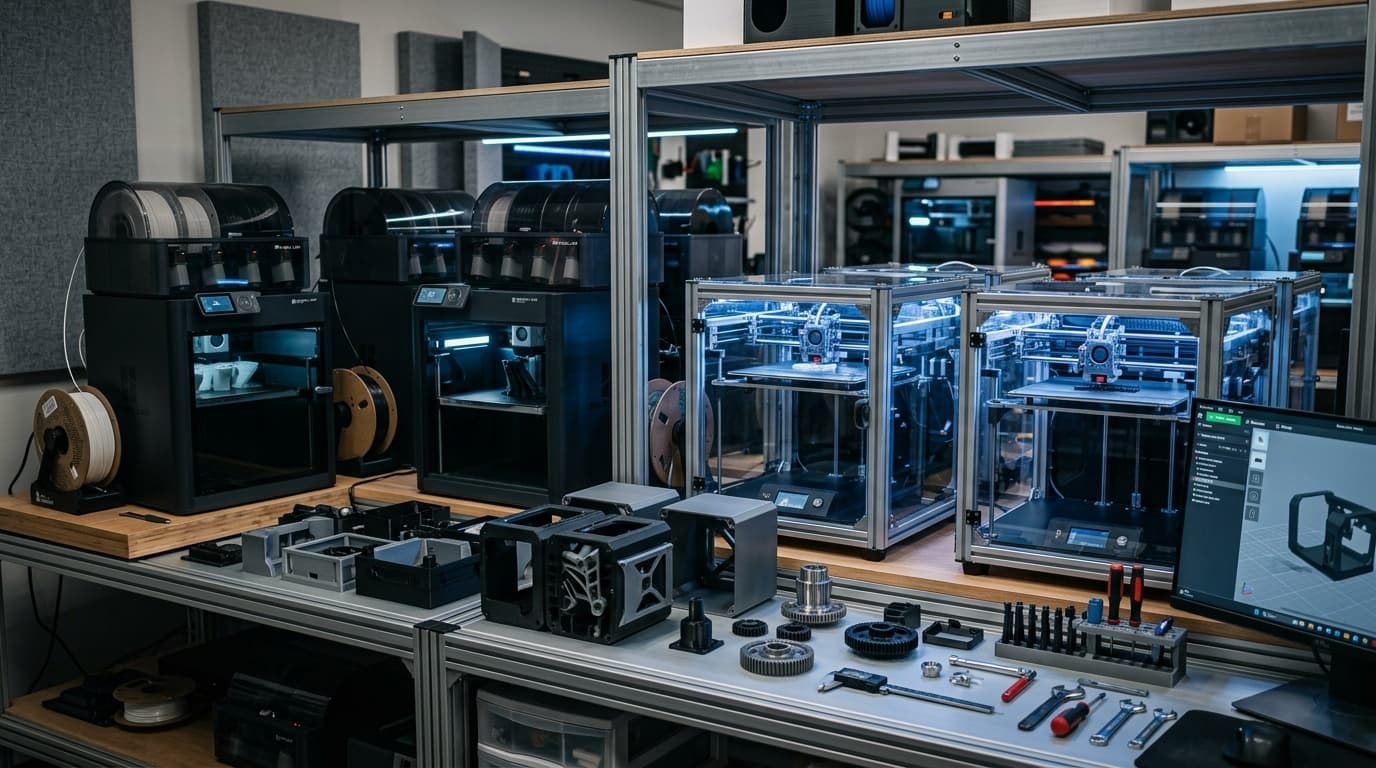
Our mechanical engineers review parts for printability, recommend the process and material, and make the DfAM changes in CAD. We print FDM and SLA in-house at our studio in Surat, Gujarat, with heat-set inserts and basic assembly, and coordinate SLS nylon and CNC machining through manufacturing partners when a part needs them. We work with teams in India and abroad, and can sign an NDA before you share files. Start with our industrial 3D printing services, see how we approach jigs and fixtures, or request a quote with your parts.