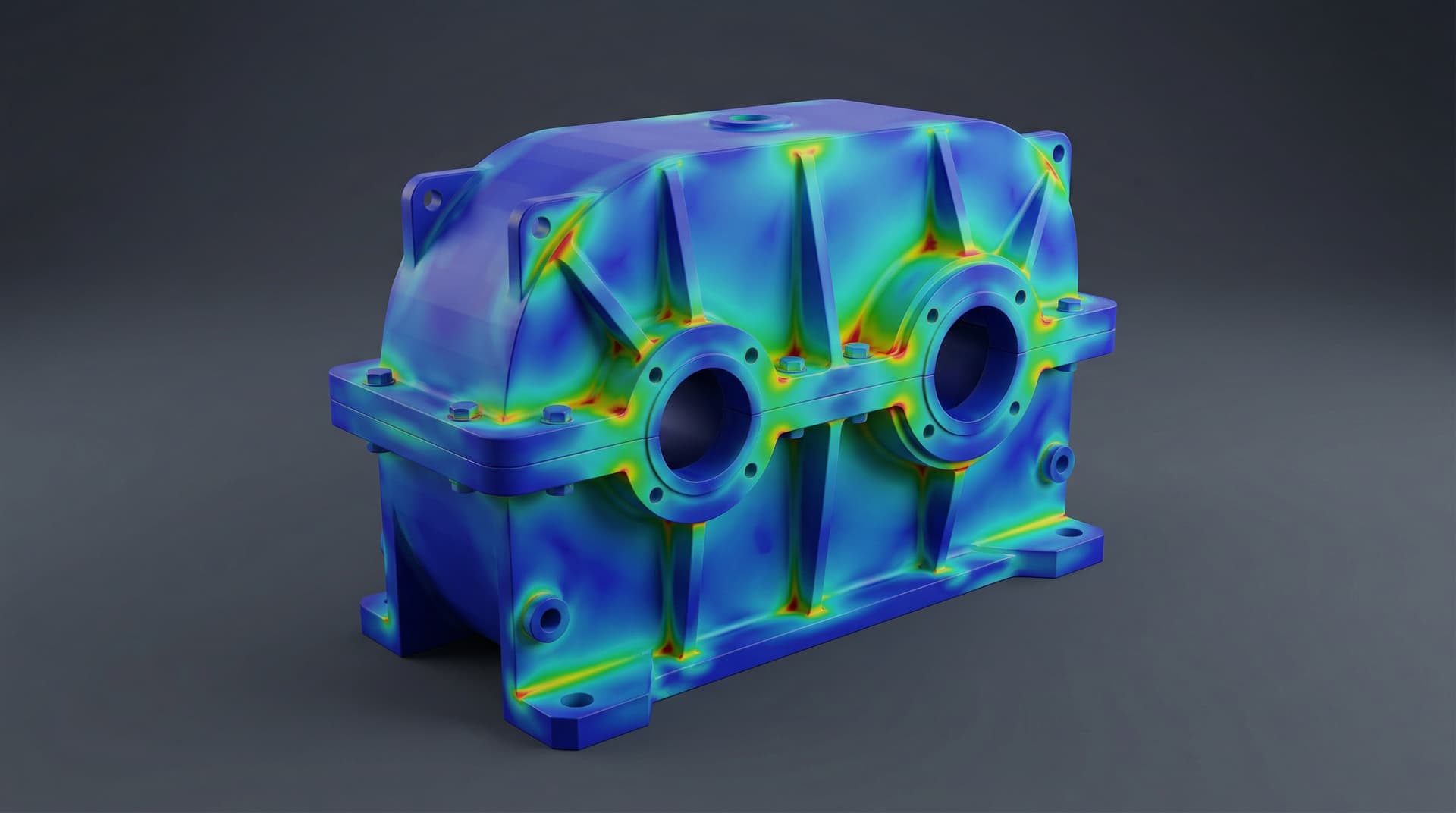
ML-accelerated simulation & design

ML-Accelerated Engineering Services

Modern engineering teams can't afford 20-minute FEA runs for every design variant. We train ML surrogates on your simulation data so exploration becomes interactive.

Machine-learning surrogate model accelerating FEA simulation

What we do

Practical support for targeted engineering work

Yantrix builds physics-informed neural networks (PINNs) and ML surrogates trained on FEA / CFD / multi-physics runs, letting engineers explore thousands of design variants in real time. We also deliver generative-design workflows (topology optimization + ML ranking), digital-twin systems that fuse sensor telemetry with simulation, and predictive-maintenance models over vibration, thermal, and current-signature data.

What problems we solve

  • Cut FEA / CFD exploration from days to minutes during concept design.
  • Expand the design search space without proportional compute cost.
  • Turn fleet telemetry into actionable predictive-maintenance signals.
  • Keep physical products and their digital twin meaningfully in sync.

Tools we use

  • PyTorch
  • JAX
  • Modulus (NVIDIA physics-ML)
  • ANSYS simulation for training data
  • SolidWorks / Fusion for parametric studies
  • Scikit-learn for classical baselines
  • Pandas / Polars for telemetry data
  • FastAPI / gRPC for model serving

Deliverables

  • Trained surrogate model with error bands and validity envelope
  • Training data pipeline tied to your simulation stack
  • Interactive design-exploration tooling or API
  • Model monitoring for drift vs. new simulation ground truth
  • Digital-twin architecture and integration notes
Use cases

Industries where this service applies

We adapt the same engineering service to different product contexts depending on the load case, packaging problem, validation target, or deployment environment.

Industrial equipment

Relevant when the project needs focused ml-accelerated engineering support.

automotive

Relevant when the project needs focused ml-accelerated engineering support.

aerospace and drones

Relevant when the project needs focused ml-accelerated engineering support.

energy and solar

Relevant when the project needs focused ml-accelerated engineering support.

robotics

Relevant when the project needs focused ml-accelerated engineering support.

consumer hardware

Relevant when the project needs focused ml-accelerated engineering support.

Related work

Case studies connected to this service

These links help visitors move from service intent to real examples of engineering work.

ML-accelerated engineering

500× faster topology exploration with an ML-surrogate FEA

A physics-informed neural network trained on 12,000 ANSYS runs replaces the full solver for early-stage topology — predicts stress fields in 40 ms vs. 22-minute solves.

Structural analysis

Reduced structural failure by 32% using FEA simulation

How simulation-driven design optimization cut peak stress by 32% and deformation by 25% on a load-bearing industrial bracket — before any physical prototype was built.

From the blog

Articles that support this service topic

Technical articles give Google more paths into the service pages and help visitors explore adjacent engineering questions before they get in touch.

3D Printing

3D Printing Services in India: How Product Teams Build Better Prototypes Faster

Learn how 3D printing services help startups and manufacturers in India validate CAD designs, reduce prototyping cost, and build functional parts faster.

Applied AI

Deploying YOLOv11 to Jetson Orin Nano at 30 FPS

Walkthrough of shipping a segmentation-class YOLOv11 model to a Jetson Orin Nano at production latency — quantization, TensorRT conversion, and the pitfalls.

Simulation

Thermal analysis for electronics enclosures

How CFD-based thermal analysis catches hotspots, airflow dead zones, and IP67-versus-cooling trade-offs in electronics enclosures before the first prototype ships.

FAQ

Questions teams ask before they engage

Service-specific questions are useful for both users and search visibility around intent-driven queries.

Don't ML surrogates just memorize the training set?

They can — which is why we care about the training-data design more than the model choice. We treat simulation as an active-learning problem: choose the samples that matter, validate against held-out physics, and publish the validity envelope so downstream users know when to fall back to the full solver.

How much simulation data do we need?

It depends on dimensionality and how smooth the response surface is. For narrow parametric studies, a few hundred runs can produce a useful surrogate. For broader design spaces we scope the data collection as the first phase.

Can this connect to our existing FEA pipeline?

Yes. We typically run training jobs against your native solver (ANSYS, SolidWorks Simulation, OpenFOAM) and serve the surrogate behind a REST or gRPC API that plugs into your existing CAD / design tooling.

Start your project

Need ml-accelerated engineering support?

Send the problem, your current design stage, and any existing files. We can scope the work from there.