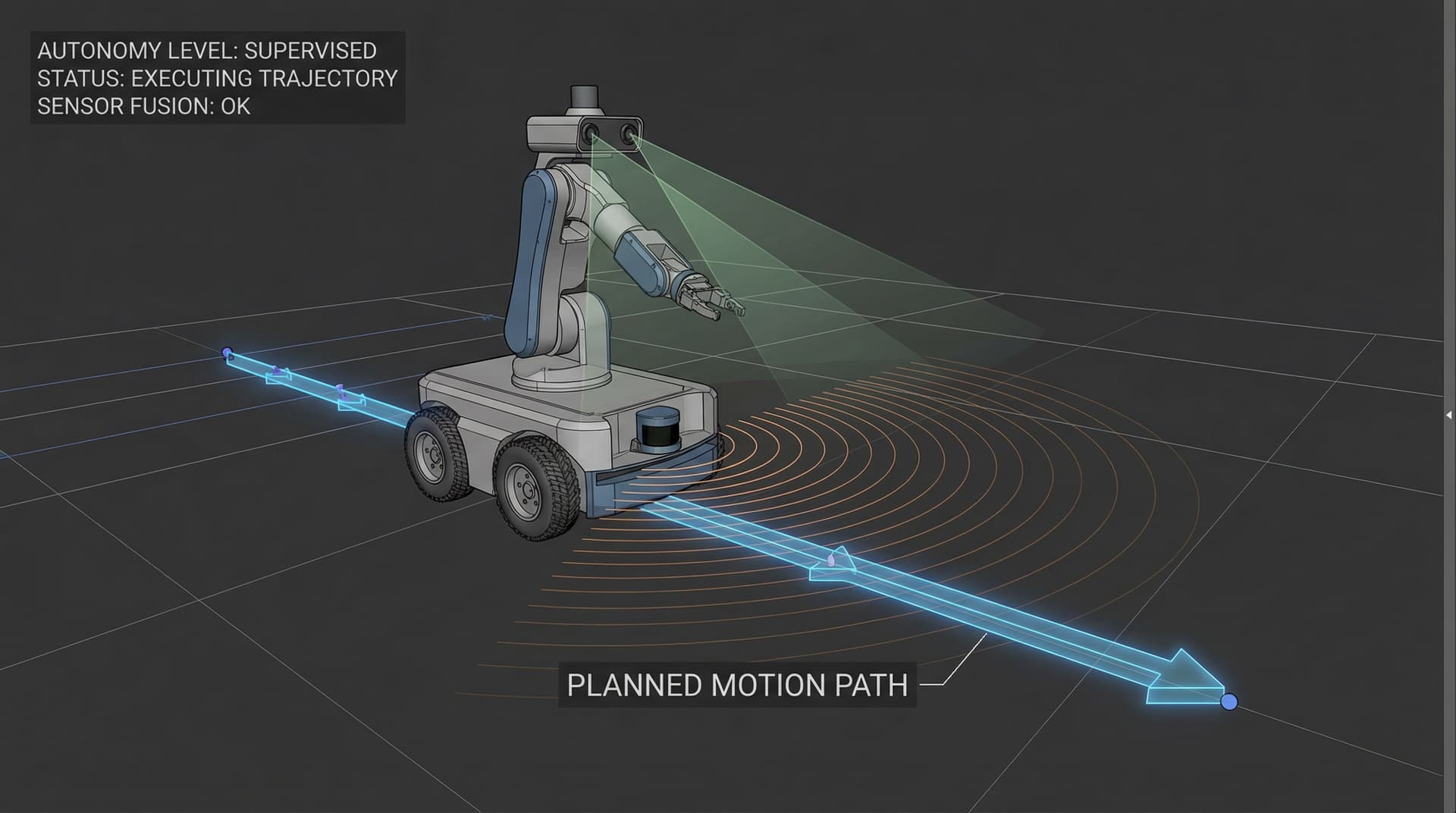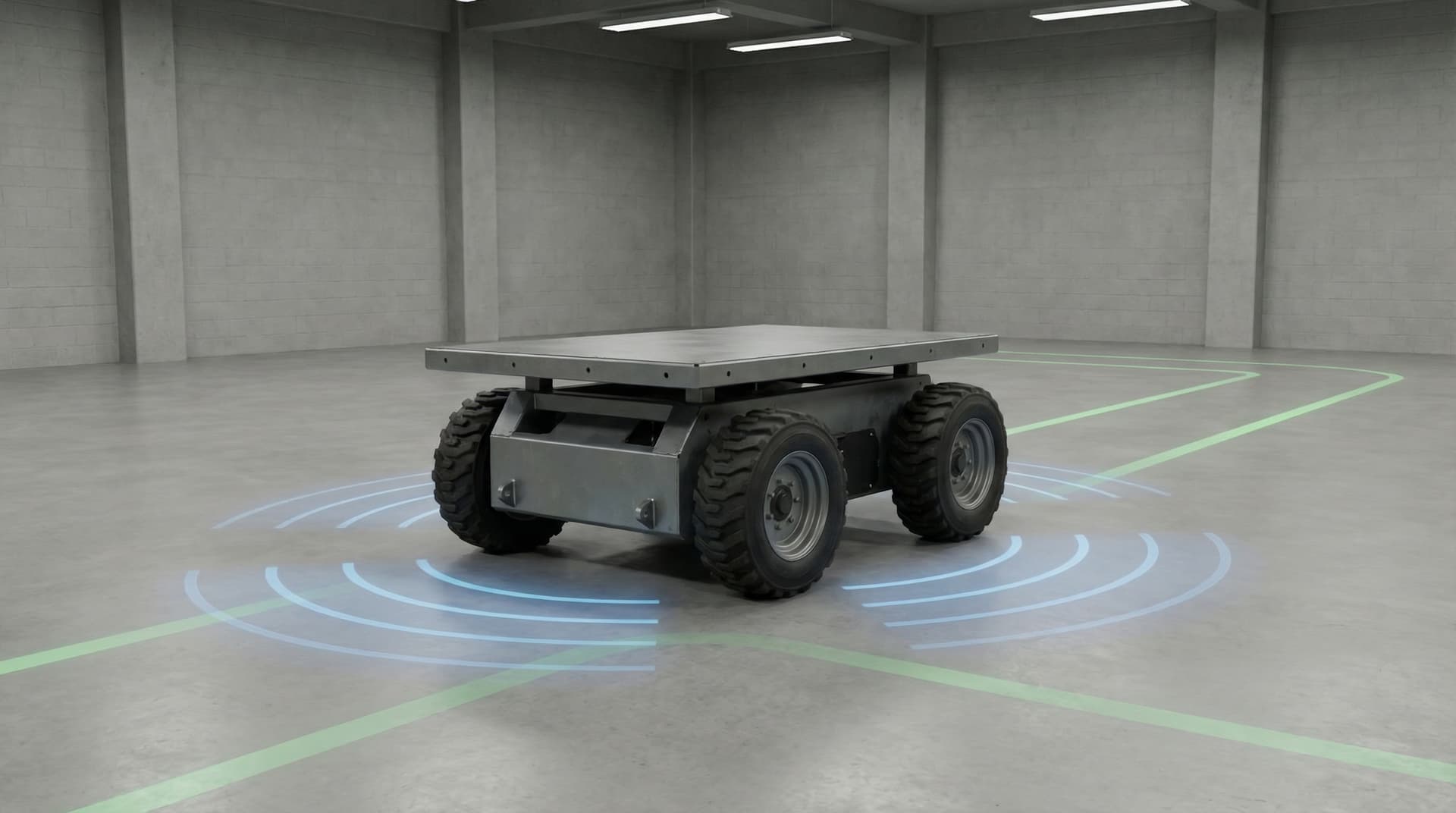
AGV vs AMR — fixed-path guided vehicles vs natural-feature autonomous robots
Understanding the architectural difference between AGVs and AMRs is the first step in project scoping:
• Automated Guided Vehicles (AGVs): Follow pre-defined physical infrastructure such as magnetic tape, floor-embedded inductive wires, or 2D QR-code grid matrices. AGVs follow fixed paths deterministically and stop when an obstacle blocks their corridor, requiring clear pathways and facility floor modifications.
• Autonomous Mobile Robots (AMRs): Navigate dynamically using natural-feature 2D/3D LiDAR SLAM and depth cameras. AMRs build real-time spatial costmaps, calculate optimal global trajectories, and dynamically steer around unexpected obstacles (pallets, forklifts, operators) without modifying facility infrastructure.
Drive-train selection — skid-steer vs differential vs omni
Drivetrain mechanics determine payload stability, turning radius, and floor wear:
• Skid-Steer (Tank-Style): Driven by two independent side wheel pairs or tracks. Offers maximum mechanical simplicity, ruggedness, and lowest BOM cost. Trade-off: tire scuffing during zero-radius spot turns on coated floors, requiring high continuous motor torque.
• Differential Drive: Two center traction drive wheels with spring-loaded corner swivel casters. Provides smooth zero-radius turning without floor scuffing and balanced weight distribution for 50–100 kg industrial payloads.
• Omni-Directional / Mecanum: 3–4 specialized rollers allowing simultaneous translation and rotation. Highly agile in narrow aisles but mechanically complex, sensitive to floor debris, and higher in cost.
Industrial safety & sensor suite (ISO 3691-4 compliance)
Industrial mobile robots must guarantee personnel safety in shared human-robot workspaces. The sensor architecture integrates:
• Safety Laser Scanners: Certified safety LiDAR placed at chassis foot-level with dynamic warning (speed reduction) and protective (instant E-stop) safety fields configured to braking distances.
• 3D Depth Cameras: Forward-facing RGB-D cameras (Intel RealSense, ZED 2i) detecting overhead overhangs, low-lying ground obstacles, and forklift tines outside the 2D LiDAR scanning plane.
• Hardware Safety Loop: Dual-channel safety relays, physical mushroom E-stop buttons, audible alarms, and optical AprilTag docking cameras for sub-2.5 cm terminal alignment at charging and conveyor transfer stations.
Commissioning, deployment timeline & budgeting reality
A custom AMR program typically spans 5–9 months: 8–10 weeks for CAD and chassis fabrication, 6–8 weeks for electronics and ROS 2 bring-up, and additional time for integration and deployment validation depending on facility requirements. Tuning localization across warehouse surfaces, reflective metal racks, and dynamic ambient lighting is a significant part of any real-world deployment.
Working with YantriX on AGV / AMR programs
We engineer custom mobile robots from concept through floor deployment. Read our Flagship Case Study on 80 kg Payload AMR Development with ROS 2 Nav2 &LiDAR SLAM to see full mechanical CAD, BOM breakdown, and docking repeatability data.Explore our Robotics Development Services in India to start your project.